
EEG: the added value of prolonged recordings
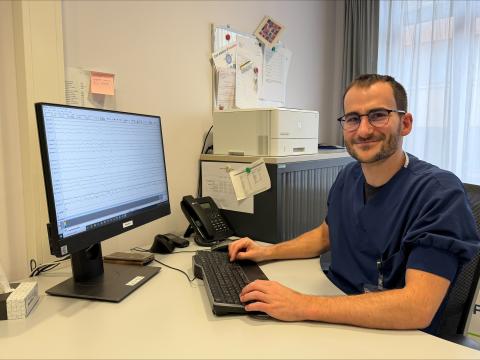
Three years ago, Dr Antoine Guilmot, neurologist, joined the Europe Hospitals with the aim of developing prolonged electroencephalogram (EEG) techniques. These techniques make it possible to expand the diagnostic toolbox and better respond to clinical needs. Below is an overview of the possibilities that EEG now offers at the Europe Hospitals.
EEG is in fact an old technique that consists of recording brain activity in real time using electrodes placed on the patient’s scalp.
“Although it is a relatively old technique, it is quite unique because it allows us to obtain real-time data reflecting brain activity,” notes Dr Guilmot.
Two types of EEG
There are two types of EEG: standard EEG and prolonged EEG.
Standard EEG is a recording that lasts between 10 and 15 minutes and is performed by a technician in the hospital, either for outpatients or hospitalized patients, in the Neurology Department or in the Emergency Department.
Prolonged EEG is a recording that lasts at least 24 hours, either on an outpatient (ambulatory) basis or during hospitalization.
Ambulatory prolonged EEG
Ambulatory prolonged EEG is mainly intended for otherwise healthy patients in whom epilepsy is suspected, or for patients with epilepsy in whom the type of epilepsy needs to be determined.
“In these patients, if the standard EEG is normal, we opt for a 24-hour recording. This has the advantage of providing a longer sample as well as a recording during sleep, during which there is also a natural activation of any potential epileptic abnormalities. This examination is therefore more sensitive for detecting epileptic abnormalities and allows for a more accurate diagnosis. It also helps justify the initiation of anti-epileptic treatment or the choice of treatment type,” explains the neurologist.
The possibility of carrying out this examination at home is greatly appreciated by patients.
Prolonged EEG during hospitalization
The other situation involves acute prolonged EEG in hospitalized patients. These are patients admitted to the Neurology ward or the Intensive Care Unit.
“In comatose or sedated patients, for whom the clinical neurological examination provides little information, EEG delivers crucial information that cannot be obtained otherwise. On the one hand, it allows us to determine the ‘degree of encephalopathy’, meaning how severely the brain is malfunctioning at that time, as well as the level of sedation, in order to adjust sedative medication,” explains Dr Guilmot.
“On the other hand, it makes it possible to rule out an otherwise invisible condition: non-convulsive epileptic seizures or non-convulsive status epilepticus, which is very common in the ICU (up to 30% of patients). These patients experience epileptic seizures without any externally visible signs, which may be the cause of the coma and/or may negatively influence their outcome.”
“Thanks to the EEG results, we can adjust anti-epileptic treatment in these patients or de-escalate certain therapies,” the neurologist adds.
In addition, prolonged EEG can also provide prognostic information:
“The most typical example is post-anoxic coma. Recent publications show that in some of these patients with non-convulsive status epilepticus, prognosis can be improved through appropriate treatment,” comments Dr Guilmot.
How does the examination take place?
The indication for a prolonged EEG is always determined by a neurologist. Once the patient has received an appointment, an explanatory procedure outlining the course of the examination is provided. For example, patients are advised to wear clothing that is easy to remove. The placement of the electrodes is carried out by a technician and takes between 30 and 45 minutes.
The patient then goes home with a recording device and a log sheet on which to note any relevant information (occurrence of a seizure, symptoms, etc.). Showering must of course be avoided, as well as the use of phones and computers plugged into the mains, as this can create artefacts.
The following day, the patient returns to the hospital to have the electrodes removed. The results are available within fifteen days. The patient is then seen either by the prescribing physician or by Dr Guilmot if specific follow-up is required.
At present, the Europe Hospitals have only one device, but they hope to double this capacity in the near future, given the significant contribution of this technique to improving patient care.
